
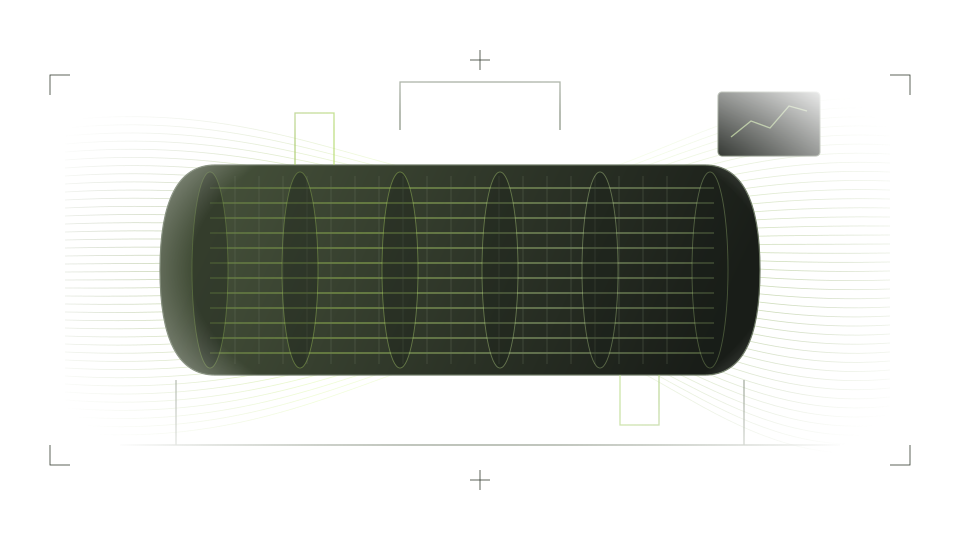
Verification examines the numerical calculation
Verification asks whether the numerical solution represents the mathematical model with sufficient accuracy for the intended use. Residual behaviour, conservation balances and the stability of engineering outputs are relevant checks. A small residual alone does not establish that pressure loss, heat transfer or another decision variable is insensitive to numerical choices.
Mesh sensitivity is about quantities that matter
Refine the mesh systematically and compare the same engineering quantities under consistent physical conditions. Watch where refinement changes the answer, particularly near walls, jets, interfaces and steep gradients. Where appropriate, a grid-convergence study can help estimate discretisation uncertainty. Agreement between two meshes is useful evidence, but is not experimental validation.
Validation compares the model with physical evidence
Validation considers how well the chosen physical model describes the real system for its intended use. Compare with relevant measurements under matching operating conditions, with measurement uncertainty in view. Matching a single measured quantity does not prove that every internal field is correct or that the model is reliable outside the conditions examined.
Report the limits alongside the conclusion
Record assumptions, boundary conditions, numerical checks and the conditions covered by the evidence. Separate numerical uncertainty from uncertain inputs and modelling limitations. If relevant measurements are unavailable, say so and define what a future test should measure. The useful outcome is a decision supported by stated evidence, not an unqualified claim that the model is validated.
Fuentes y lecturas adicionales
Servicio relacionado
Revisión de modelos y estudios a medida
Saber qué respalda el modelo, dónde persiste la incertidumbre y qué debe verificarse.
Explorar servicios